
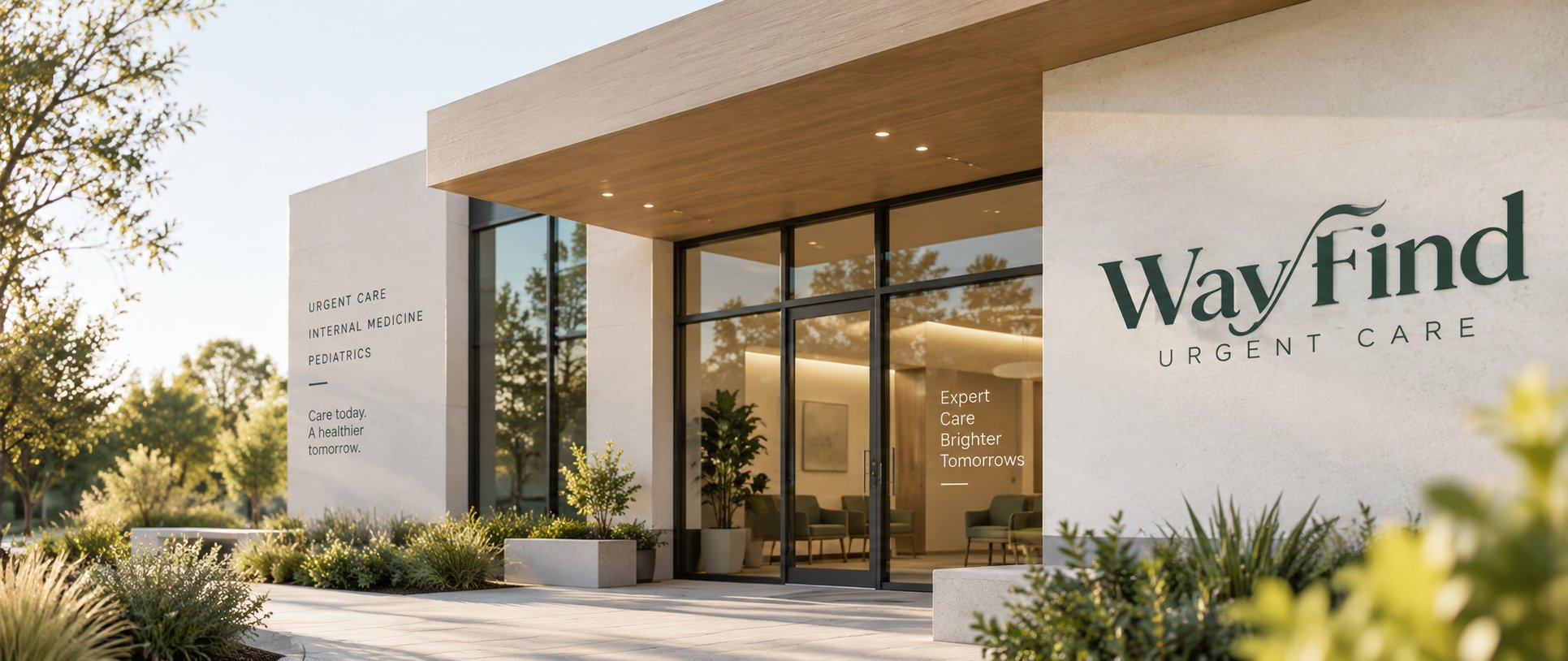
Urgent Care · Internal Medicine · Pediatrics
Concierge medicine.Without the concierge fee.
One roof. Three demand engines. A physician-led platform scaling from 8 to 40 multi-specialty clinics across Southern California — built on proven, high-margin clinic units and an AI layer that gives providers their time back.
Management base case, 2027–2032. Projections are uncertain and may differ materially.
What urgent care actually is
Urgent care sits between your doctor's office and the emergency room. Same-day, walk-in medical care for the things that can't wait for an appointment but don't belong in an ER.
Fractures and sprains. Cuts that need stitches. Fevers, infections, asthma flares, dehydration, chest pain that needs to be ruled out today. In a conventional system those visits often default to an emergency department — the most expensive room in American healthcare — because nothing else is open.
WayFind runs ED-lite sites: advanced imaging including CT and MRI, complex labs such as cardiac troponins, and antibiotics usually reserved for admitted patients. That widens the case mix a site can safely keep rather than refer — better for the patient, and materially lower cost for the system.
One site,
three engines
Adult urgent care, pediatric urgent care and internal medicine in a single location, on the same hours. Each service line is a distinct demand engine, and each one feeds the other two.
Industry urgent-care-to-primary-care conversion versus the rate this model is underwritten to achieve — roughly 3.0× patient lifetime value.
Urgent Care
Acute walk-in demand handled with ED-lite capability, which widens the case mix the site can retain rather than refer.
Pediatric Urgent Care
A parent satisfied with their child's care is the most reliable path to converting the rest of the family.
Internal Medicine
Easy access to cutting-edge care most traditional practices ignore — biome optimization, GLPs, hormone and brain health.
Recurring primary care relationships and premium cash-pay services smooth the seasonal visit-volume volatility that constrains valuation for pure-play urgent care platforms.
Where AI compounds the model
This doesn't come from optimizing AI. It comes from using AI to buy back time and space for what makes healthcare exceptional — the genuine connection between patient and provider.
Applied at the point of care and across the back office, AI extends provider capacity, tightens the revenue cycle, and closes the loop between urgent care and primary care.
AI Front Desk
Conversational AI handles check-in, insurance verification and intake — cutting wait times and front-desk cost per visit.
AI Chart Prep
Before the door opens, AI distills the full chart, history, prior visits and risk flags into a one-screen brief.
AI Ambient Scribe
Listens to the visit and drafts the note in real time, cutting documentation and freeing capacity per shift.
AI Clinical Decision Support
Evidence-based prompts flag drug interactions, red-flag symptoms and guideline-driven next steps at the point of care.
AI Discharge & Follow-Up
Plain-language after-visit instructions plus automated follow-up that routes acute UC patients into the primary care panel.
AI Billing & Coding
Automated coding, claim scrubbing and denial prevention lift clean-claim rates and speed cash collection.
Six-year base case
| $ in millions | 2027 | 2028 | 2029 | 2030 | 2031 | 2032 | 6-Yr |
|---|---|---|---|---|---|---|---|
| Net revenue | $14.4 | $50.8 | $100.5 | $155.7 | $213.2 | $248.6 | $783.3 |
| Platform EBITDA | ($1.0) | $9.0 | $27.7 | $50.8 | $75.1 | $93.0 | $254.6 |
| EBITDA margin | (7.1%) | 17.8% | 27.6% | 32.6% | 35.2% | 37.4% | 32.5% |
| EBITDA less growth CAPEX | ($8.7) | $2.4 | $21.1 | $44.2 | $68.5 | $93.0 | $220.6 |
Revenue per mature site at a 42% operating margin.
Time to contribution-positive on an acquired clinic.
Lower capital to open, same mature economics.
Collection assumption behind ~$156 net revenue per visit.
Total growth capital to fund all 40 clinics plus a one-time technology and AI build. The platform turns self-funding as EBITDA-less-CAPEX crosses positive during 2029.
Near-immediate cash flow, ~9-month ramp to full run-rate.
De novo sites in proven catchments; lower capital per unit.
One-time platform build across the six AI modules.
Lean central overhead — ~$19M total over six years.
Southern California first
We build where our operating partner already expanded urgent care at scale — known payer mix, known referral patterns, known real estate.
Known territory
Our operating partner led urgent care expansion across Southern California inside one of the country's largest ambulatory networks — payer mix, referral patterns and real estate are already understood.
Fragmented supply
Independent single-site urgent care operators dominate the market and lack the capital, technology and primary-care attachment to convert acute visits into panels.
Pure-play comparables
Urgent-care-only platforms carry seasonal volume volatility that compresses multiples. Recurring IM relationships and cash-pay programs smooth it.
Cost pressure tailwind
Payers and employers are actively moving volume out of the ER complex. ED-lite capability is exactly the site of care they are trying to fund.
Operators, not spectators
Dr. Joe Chambers, MD
Board-Certified Internist · Urgent Care & Primary Care Physician Executive
- Chair, Department of Urgent Care — Facey Medical Group / Providence.
- Chair of the system's Urgent Care Quality Committee, covering sites from Alaska to New Mexico.
- Directly oversaw a portfolio of urgent care centers generating 90,000+ annual visits at a 32.3% EBITDA margin.
- Built the "ED-lite" model: advanced imaging, cardiac troponins and hospital-grade antibiotics delivered in urgent care to avoid unnecessary ER visits and admissions.
Providence Health & Services · Facey Medical Group · Ambulatory Care Network
[ Name ]
Chief Executive Officer
Placeholder bio — two or three sentences on prior platform building, P&L scale and why this model.
[ Name ]
Chief Financial Officer
Placeholder bio — healthcare services finance, M&A integration and lender relationships.
[ Name ]
Chief Medical Officer
Placeholder bio — clinical quality, provider recruiting and standard-of-care design across sites.
[ Name ]
Chief Operating Officer
Placeholder bio — multi-site operations, staffing models and de novo openings.
Flexible schedules.
Full-time coverage.
Our staffing model is built in full-time equivalents, not rigid full-time seats. A physician who can work two or three days a week — often a parent returning to practice — is a first-class hire here. Three of them cover one FTE, and the site never notices the seam.
A physician can build a real career here on a two- or three-day week.
Coverage is planned in full-time equivalents, assembled from part-time clinicians.
All three service lines open and close together, so shifts interlock cleanly.
Flexibility is our recruiting edge in a market where provider turnover is the largest hidden cost.
Where to find us
Placeholder addresses · replace per site
[ Clinic One ]
000 Lake Avenue, Pasadena, CA 91101
Open daily 8a–8p
Urgent care · Pediatrics · Internal medicine · CT
[ Clinic Two ]
000 W Magnolia Blvd, Burbank, CA 91505
Open daily 8a–8p
Urgent care · Pediatrics · Internal medicine
[ Clinic Three ]
000 N Brand Blvd, Glendale, CA 91203
Open daily 8a–8p
Urgent care · Pediatrics · X-ray · Labs
[ Clinic Four ]
000 Valencia Blvd, Santa Clarita, CA 91355
Open daily 8a–8p
Urgent care · Internal medicine · MRI
From the founder's desk
Why your urgent care visit should end with a doctor, not a discharge sheet
Six minutes on what happens after the visit — and why the follow-up is where American primary care quietly breaks down.
Subscribe · Apple · Spotify · RSS
Placeholder headline for a press mention or byline.
Placeholder guest appearance with episode link.
Placeholder panel or keynote on ambulatory care economics.
Placeholder publication or quality-committee citation.
Request access
The full financial model, clinic-level unit economics, acquisition pipeline and technology plan are available to qualified investors under NDA.
- Full six-year financial model with clinic-level build-up
- Acquisition pipeline and diligence framework
- Technology and AI implementation plan
- Provider staffing model and compensation design